The world premiere of Art Shulman’s Bias offers a thought-provoking look at possibly knowing or unknowing bias, perhaps even outright discrimination, within the microcosmic setting of academia where lines are drawn between a professor and one of his foreign students. Over the course of nearly two hours at the Hudson Guild Theatre in Los Angeles, attendees will find themselves identifying with not just multiple vantage points but cogitating over some of the play’s topical and compelling arguments, which are “suggested” by a true story that transcends simplistic black-or-white conclusions.

Joshua Goldman (Jerry Weil), a rigorous professor of 15 years at an unnamed stateside university, reports pupil Ali Alkashar (Aziz Tazi) of Saudi Arabia to student affairs for cheating, on the advice of department chair Dr. Kate O’Connor (Nina Bell), when he observes that Ali is among three Muslim students who have answered verbatim on three out of four short-answer questions. (One of the three involved in the suspected deception is Ali’s girlfriend Fatima, portrayed by Rasha Elabaji, who has historically been a high-performing student.) Goldman’s accusation gives way to Ali’s counter — filed through the university’s diversity and equity office — that Goldman, a Jewish instructor, acted with blatant discrimination.

With a Ph.D. in Psychology and a 20-year career as a professor of marketing at Cal State Northridge, Shulman’s writing cuts deep beyond platitudes and verisimilitude to uncover the positive and potentially negative qualities that define human nature. As both playwright and director, Shulman’s touches feel authentic, particularly in the way the play is framed with a critical-thinking and sometimes rhetorical eye by an educator in Goldman who begins the show with an audience-aimed query about what the capital of Illinois is before opining on humanity’s carbon footprint, an issue perhaps exacerbated by the wealthy.
When Goldman makes a reference to Ali’s “pretty” girlfriend Fatima and then remarks that Ali, who is paying three times the tuition as an international student, must be affluent hailing from a country that has ballooned its GDP on oil, tensions are palpable even if they’re subtle. When Goldman makes the uncouth connection between oil and a carbon footprint Ali is at least indirectly responsible for, it seems that the undergraduate may very well have a case for being targeted.
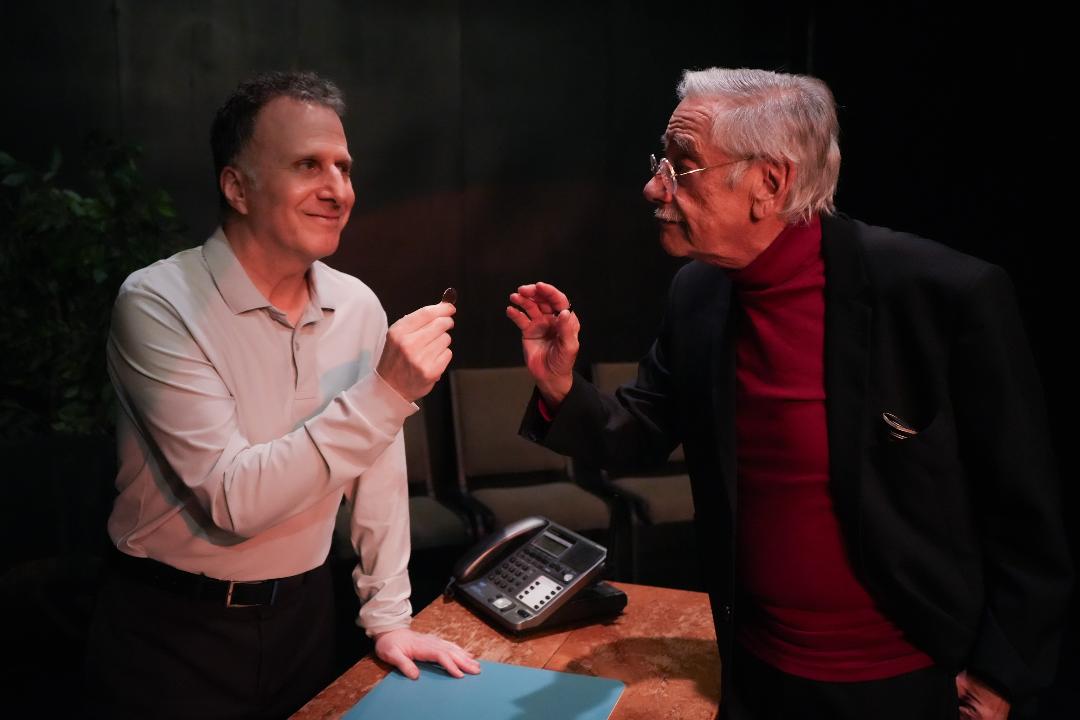
Goldman is far from perfect, but he also has several valid points, delivered with a combination of confidence and anxiety-induced neuroticism by Jerry Weil who terrifically anchors the play’s most significant role. An audience member may find Goldman unlikeable at times but also be cogently swayed by a rousing dialectic speech at the arbitration hearing in Act II — a credit to Weil — which breaks the words “bias” and “discrimination” down to their constituent parts.
Evidently, aren’t we all biased in some way due to personal pride emanating from our heritage, or the lived experiences that only those living them could align with at a core level? And while bias can color interpretation, it may very well be justified, too, based on evidence that sparks suspicion. Most importantly, bias and discrimination don’t have to be inherently entwined — for example, one’s feeling of superiority in one area doesn’t automatically presuppose or prelude an action disadvantaging a race, ethnic group, or protected class. There are, indeed, levels to this, which is a crucial observation in a warped, social media-fueled world thriving on “right”-or-“wrong”-side absolutes.

As Ali Alkashar, the conceivably wronged student with a chip on his shoulder (earned through Ali’s perspective), Aziz Tazi infuses his persona with a sense of rich believability. Ali, despite coming from a dissimilar culture, is apt to feel out of place — an explanation for why he hasn’t attended many classes — and lean on classmates of a similar background he perceives a closer connection to. Hence, a school’s “Middle Eastern Mafia” might be much more innocuous than the term implies, referring merely to students from that region of the world who share their understanding of class materials with each other. Is a consequence of this always cheating? Maybe, maybe not, but statistical probability is also difficult to argue against.
Nina Bell’s Dr. O’Connor, a professional ally and friend to Goldman, fulfills the part of a major voice, sometimes one of rationality, for the beleaguered professor. Bell’s laidback and naturalistic style blends well with Weil’s, yielding myriad conversational exchanges that could surely be witnessed at any university.

And just as O’Connor challenges Goldman on certain assumptions, Rasha Elabaji’s Fatima does the same for Ali. Elabaji adeptly balances the commiseration she has for her character’s boyfriend with interesting counterpoints of her own — specifically that she doesn’t feel discriminated against. Fatima, moreover, posits the possibility that through actions of his own implying probable cause, Ali brought some of the conflict upon himself (and yet a parallel case could be made for Goldman having done the same).
Andrée Mulia effectively depicts April Walters, the soft-spoken and well-intentioned equity and diversity officer investigating Ali’s claim of discrimination. To the audience, April is an amiable human being in an unenviable position, but to Goldman, she is feasibly an obstruction to the justice that he is clearly deserving of.

It should be mentioned that, despite principal inroads made into the plot, Act I tends to languish with pacing and transitions that could be a little crisper. Nevertheless, Act II resoundingly benefits from the introduction of two key characters and the charismatic actors playing them: Morry Schorr’s Omar Bashar, an Egyptian-born union representative assigned to Goldman, and Sammie Wayne IV’s Javier Ramirez, a retired justice who arbitrates Goldman and Ali’s hearing. Schorr entertainingly captures his role as an administrative advocate, redirecting Goldman away from self-pity and to the facts, and turning simple lines into hilarious zingers. Similarly, whereas most actors would have phlegmatically uttered their lines as the authority-holding arbitrator, Wayne IV gives the play a rejuvenating dose of adrenaline with his commanding charm and mature swagger. It is because of his engrossing performance that the play’s outcome comes across as more thrilling than it otherwise would have.
In an era when thoughts, let alone actions, are adjudicated more harshly than ever on the back of social and political movements — not just within society at large but within academic institutions where such considerations are amplified and received with greater credence — Art Shulman’s Bias is both timely and incisive. As different as we appear, the truth is we’re all human in the center — a message recurringly imparted via the metaphor of an M&M candy dispenser present in every scene.

Being culturally sensitive should, undoubtedly, be a requirement for everyone — if nothing else, it bridges the gaps that set us apart, bringing us together. But if one commits a folly by failing to err on the side of caution and ends up on the “wrong” side of correctness, perhaps it would behoove us to afford that person the benefit of the doubt. To arrive at this insight, one would be better served replacing emotional appeals with those powered by critical thinking and reason. The brass tacks of Bias compellingly reminds us of this.
Cover image caption: Left to right are Jerry Weil and Aziz Tazi in the production of Bias at the Hudson Guild Theatre in Los Angeles, CA. Photo credit: Aziz Tazi.
Art Shulman’s Bias runs through Sunday, Dec. 14th at the Hudson Guild Theatre in Los Angeles, CA. For more information on the production and to purchase tickets, visit onstage411.com.


